
Have any questions?
We’ll help you select the right timing and control solution for your facility.
NHRA-caliber drag timing — PC-based 2750 XL console, tri-beam starting line, every split from 60ft to the finish, 24" scoreboards with win lights, and reflector-based 3040A detection.
The full-feature RaceAmerica drag package. The 2750 XL console runs wireless to the tree, the starting line, and every split position, with RA Command Drag handling race management from a PC in the tower. Tri-beam starting line electronics add the guard beam that keeps cars from staging too deep — the difference between a bracket night and a sanctioned eliminator.
Every split is covered: 60ft, 330ft, mid-track, 1000ft, and end-of-track ET and speed. That's the full incremental picture a racer expects on a timeslip at this level, and it's what makes the data worth publishing.
Detection is the new 3040A. Emitter and sensor sit together in one housing on one side of the lane and read off a passive reflector on the other — so nothing powered goes across the track at any beam position. Nothing to charge on the far side, nothing to align across the lane, and half the units to set out at every split on a strip that has five of them.
24" scoreboards carry the numbers to roughly 1000 feet, with win lights calling the winning lane the moment the first car crosses, and a two-lane dial-in board at the starting line so racers and the crowd can see the dials before the tree comes down. The timeslip printer goes trackside on a wireless link rather than living in the tower, so drivers collect slips where they actually pull off.
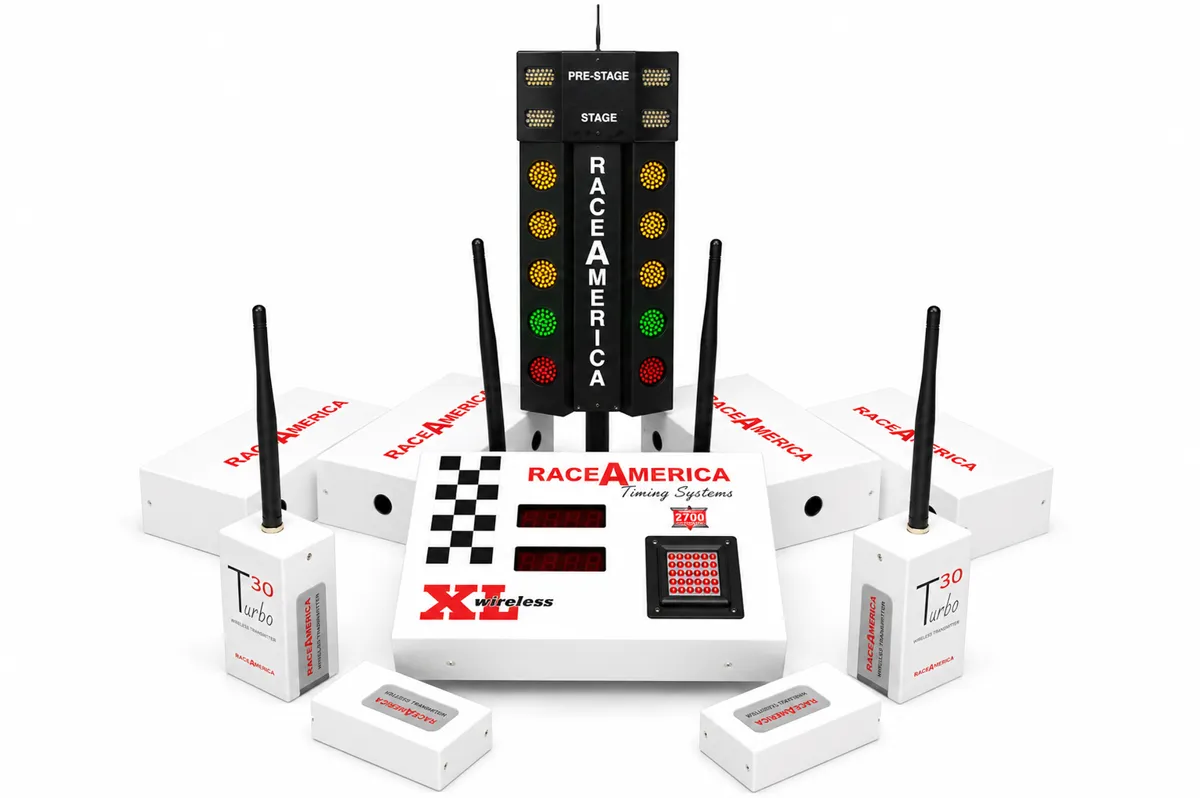
PC-based wireless console for tower operation.
Pre-stage, stage, and guard beams, both lanes.
Double-sided LED tree, 110VAC/230VAC, wireless to the console.
Reflector-based detection across every beam position — nothing powered on the far side of the track.
End-of-track ET and speed.
60ft ET split.
330ft ET split.
Mid-track ET and speed.
1000ft ET and speed for 1/4 mile.
Two displays, one line of 24in digits each, wireless data link built in. Readable to 1000 feet.
One per lane. Calls the winning lane the instant the first car crosses.
Two-lane dial-in display at the starting line.
Includes serial interface, ribbon, and paper.
Puts the printer trackside instead of in the tower.
Mains power for the trackside wireless unit.
900MHz directional antenna and 20ft cable — coverage down a full-length strip.
50ft cable — starts the DTSS tree from the lane.
One per beam position.
PC race management from the tower. Includes a one hour remote training session.
RaceAmerica XL timing systems meet NHRA national-event standards. Contact us to confirm current certification for your specific event sanctioning.
It combines the infrared emitter and the track sensor in one housing on one side of the lane, reading off a passive reflector on the other side. Only the reflector goes across the track. With five beam positions on a strip this size, that's half the powered units to set out, charge, and align — and nothing on the far side that can run flat mid-round.
Viewing distance. 24in digits stay readable to roughly 1000 feet against about 660 for 15in. On a full-length strip with a deep grandstand, that's the difference between the crowd reading the numbers and taking your word for them.
As quoted, the timeslip printer sits trackside on a 4520D2 wireless RS232 unit rather than in the tower, so drivers pick up slips where they pull off instead of sending someone up and back. We also quote the in-tower arrangement (6034D adapter) if you'd rather keep it beside the console.
At the starting line, the double-sided DTSS tree and a two-lane dial-in board (4528D) showing both dials before the run. At the finish, 24in scoreboards with the ET and speed, and win lights (6704C) calling the winning lane the instant the first car crosses. Then the timeslip, printed trackside.
Not by default. RA Command Drag includes a one hour remote training session; onsite install, commissioning, and staff training are available as add-ons. Request a custom quote with installation included.
Tell us about your strip length, tower layout, existing infrastructure, and sanctioning. Common additions here: a console carry case, live timing so results publish online, extended warranty service on the timing system and scoreboards, and onsite commissioning. We'll send a final quote within one business day.
We’ll help you select the right timing and control solution for your facility.