
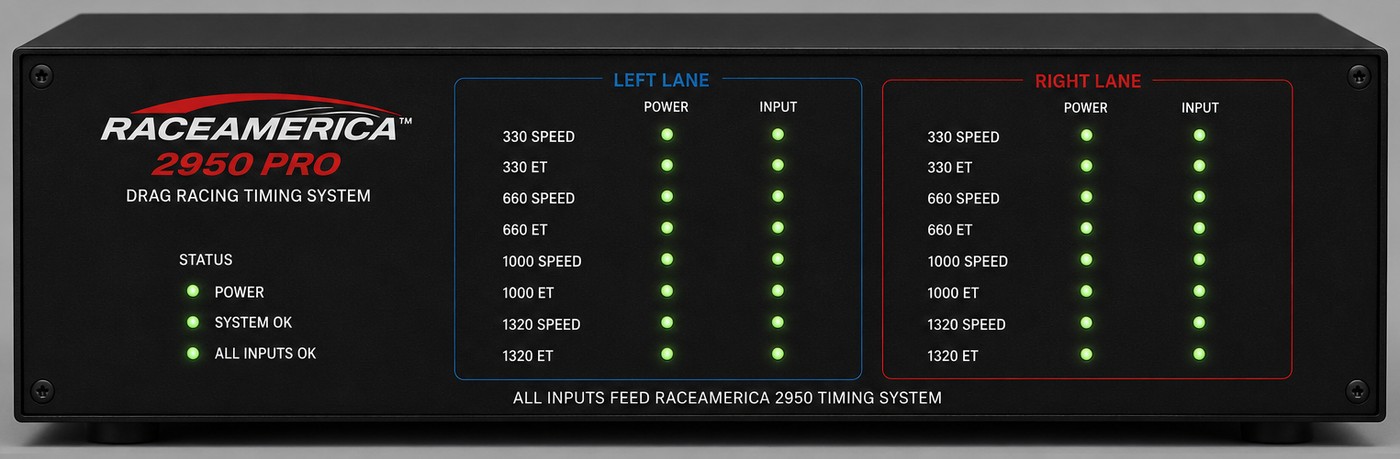
2950 Pro Central Timing Controller
Central timing controller that replaces the box in the tower without disturbing the home runs already in the ground.
Every system we sell is configured for the facility it runs at. Tell us about your track and we'll spec the right setup and price it, usually within one business day.
Request a QuoteSpecifications
| Application | Central timing controller for permanent professional drag racing facilities, left and right lane |
| Timing architecture | RaceAmerica 2900-series central timing |
| Timing inputs | 16 dedicated, 8 per lane |
| Timing points | 330, 660, 1000 and 1320 ft - ET and speed on both lanes |
| Time accuracy | 0.001 seconds |
| ET timer capacity | Up to 90.000 seconds |
| Speed capacity | Up to 999.99 |
| Speed accuracy | 0.01 MPH or km/h |
| Track connection | ST fiber bulkhead and wired sensor connector on every input |
| PC communications | USB type B to the control PC |
| Network | RJ-45 system port |
| Power | 12V DC, 5A maximum |
| Chassis ground | Rear-panel ground stud |
| Mounting | Desk placement or wall mount |
| Software | RA Command Drag |
| Origin | Made in USA |
Features
- 16 dedicated timing inputs — eight per lane, one per measurement
- ET and speed at 330, 660, 1000 and 1320 ft on both lanes
- ST fiber and wired sensor connector on every input
- Power and Input indicator for each of the sixteen inputs
- Status group: Power, System OK, All Inputs OK
- Reuses existing home-run infrastructure - no trackside T-Links required in the retrofit configuration
- One enclosure, desk placement or secure wall mount
- USB to the control PC; RA Command Drag runs the event
Description
A central timing controller for permanent professional drag racing facilities, built to replace the box in the tower without touching what is buried under the track. Sixteen dedicated inputs land the existing home runs directly on RaceAmerica timing hardware — eight per lane, one for every measurement: ET and speed at 330, 660, 1000 and 1320 feet.
Every input appears twice on the rear panel, an ST fiber bulkhead and a wired sensor connector on the same channel. A facility that ran fiber keeps its fiber and one that ran copper keeps its copper. The conduit and the home-run cable are the expensive, long-lived part of a drag strip, and none of it has to come up to move the tower onto RaceAmerica.
Each input carries its own Power and Input lamp, so a fault narrows to a lane, a distance and a sensor function before the next pair runs rather than after a run is lost. Precision timing stays in hardware; the PC runs the event over USB with RA Command Drag.
Start line, staging, the tree, reaction time and 60-foot ET sit outside these sixteen inputs and are supplied separately. Every retrofit is configured against the facility's existing home-run infrastructure — send us the track's sensor and home-run detail and the configuration comes back priced.